10% off for registered customers!
ARGO - RNA Library Preparation Kit
RNA Library Preparation Kit with a fragmentation-free, stranded, UMI-labelled workflow for both intact (high-quality) and degraded RNA samples, while also being optimized and tested with our ribodepletion solution (riboPOOLs).

Optimized with riboPOOLs

Seamless integration with riboPOOLs. Prior rRNA depletion significantly improves the quality of results!
Challenging Input, no problem

ARGO is validated on intact & degraded RNA as well as FFPE samples. It handles a wide input range (1 ng – 1000 ng) showing superior performance at low quantities.
Time Saving

ARGO provides sequencing-ready libraries in just 4.5 hours.
Adjust Library size

Provides fragments for gene quantification or extended reads to capture splice variants, transcript isoforms, and fusion events.
RNA Sequencing (RNA-Seq): Transcriptome Analysis & Gene Expression Profiling
What is RNA Sequencing?
RNA sequencing (RNA-Seq) is a next-generation sequencing (NGS) technology that captures and quantifies all RNA molecules in biological samples, delivering comprehensive transcriptome profiling and gene expression analysis. This genomics technique enables researchers to decode disease mechanisms, identify biomarkers, and discover therapeutic targets across cancer research, immunology, neuroscience, and precision medicine.
RNA-Seq Applications
- Differential gene expression (DGE): Quantify gene expression changes between conditions and disease states
- Alternative splicing detection: Identify splice variants, exon skipping, and isoforms
- Non-coding RNA profiling: Detect lncRNAs, circRNAs, microRNAs, and regulatory RNAs
- Variant calling: Discover SNPs, SNVs, indels, and mutations
- Gene fusion identification: Detect fusion transcripts in cancer genomics
- Pathway analysis: Map genes to biological pathways and networks
RNA Library Preparation for NGS
Exceptional RNA-Seq data begins with quality RNA library preparation. Advanced library prep kits convert fragile RNA to robust, sequencer-ready cDNA libraries for Illumina and other NGS platforms.
Modern workflows integrate unique molecular identifiers (UMIs), dual indexing, and strand-specific protocols—minimizing PCR bias, maximizing sequencing accuracy, and eliminating technical variability for reliable gene expression measurements.
ARGO Workflow
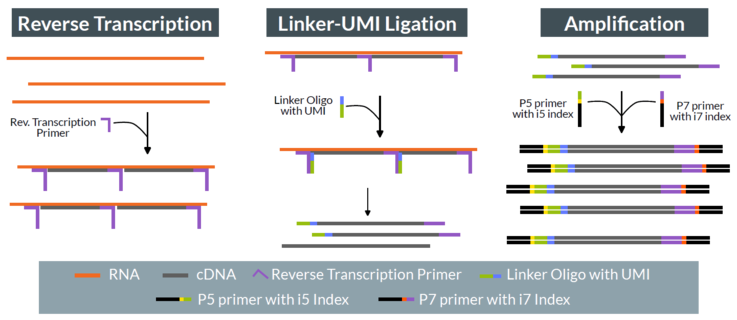
Validated on a wide range of species

a)

b)

c)
Figure 1 Library profiles of a) Rattus norvegicus (rat), b) Lendenfeldia chondrodes (sponge) and c) Pinus sylvestris (pine tree) generated from 100 ng of total RNA depleted with siTOOLs Biotech riboPOOLTM rRNA-depletion kit. Bar plots show percentages of rRNA and RNA of interest in samples before and after ribodepletion with riboPOOLs.
FAQ
Have any unanswered questions? Feel free to ask: info@sitools.de
Which species are compatible with Argo RNA Library Prep?
Argo RNA library preparation kit is compatible with RNA from any species, including human, mouse, rat, plant, bacterial, fungal, and microbial samples, provided sufficient starting material is available. Successful RNA-Seq data analysis and read mapping requires an appropriate reference genome or transcriptome for sequence alignment and gene expression quantification.
What sequencing format should I use for Argo libraries? Single-read or paired-end sequencing?
Argo cDNA libraries are fully compatible with both single-read (SR) and paired-end (PE) sequencing configurations on Illumina sequencing platforms:
- RTM libraries (RNA-Seq QuantSeq): Optimal sequencing results with SR50-150 or PE50-75
- RTL libraries (long-read RNA-Seq): Optimal sequencing results with SR150 or PE100-150
Your specific research application, transcript coverage requirements, and sequencing depth needs may influence the most appropriate NGS sequencing format and read length.
Can I use Argo with degraded RNA or FFPE samples?
Yes, degraded RNA samples and FFPE (formalin-fixed paraffin-embedded) tissue samples are fully compatible with Argo library preparation workflows that incorporate ribosomal RNA depletion. For these challenging, low-quality sample types with fragmented RNA, we strongly recommend using RTM rather than RTL, as RTM protocols are specifically optimized for compromised RNA quality, partial degradation, and limited RNA integrity (low RIN scores).
What is the recommended RNA input amount for Argo library preparation?
Argo library prep kit accommodates flexible RNA input ranging from picograms to micrograms:
- For rRNA depletion workflows: Use 1 ng – 1 µg total RNA as starting material before ribosomal RNA removal. We recommend our riboPOOLs for optimal rRNA removal efficiency and transcript coverage.
- For direct total RNA input without depletion: 100 pg – 100 ng total RNA can be processed directly without prior rRNA depletion or poly(A) enrichment, depending on your application needs, sample availability, and desired sequencing depth.
